Extension of the CxG formalism to group activity
A group activity is a sequence of individual interventions of actors, interventions being considered as independent subtasks. As a consequence, the activity of each actor becomes a set of independent subtasks in the group activity, and group mental model must be built as a sequence of actors’ interventions). Building a group mental model consist of adding an actor's independent subtask at the end of the sequence of previous independent subtasks already built and assembled, once the last subtask has its contextual elements instantiated. This double operation of building and developing the group mental model is managed by reserved contextual elements that controls the cyclic use of the directed acyclic contextual graph by determining which actor (net manager) has to take in charge the next cycle and for which independent subtask (marked as task_status). The cyclic use of the directed contextual graph (at implementation level) relies on the concepts of turn (the crossing of the contextual graph for developing an independent subtask) and shared context (transfer of information between turns). Figure 2 presents the four-modelilng level framework description (extension of previous one)
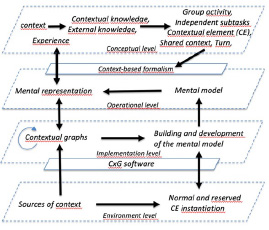
LFigure 2 Group activity at the four modelilng levels
The cyclic use of a contextual graph is concretised on figure 2 at implementation level by the rounded arrow at the head of the word “Contextual graphs”. Mental-model building results of the paths used in a cyclic way in the contextual graph. At operational level, the arrow from mental model to mental representation on figure 2 points out the fact that, once built, the mental model could enrich the group mental representation. Reserved contextual elements are manager, sender, recipient and task_status. The manager is the actor that executes an independent subtask on request of a sender, the independent subtask being identified by task_status and transmitted to recipient. The contextual graph is organised for supporting turns with (1) selection of a manager (instantiated by an actor) for realising an intervention, (2) selection of an independent subtask in manager’s activity to perform, (3) the designation of the next manager and its independent subtask to execute at the next turn. As such, a sequence of turns constitutes a CxG-based simulation.
The shared context contains the previous results, normal and reserved contextual elements that the manager can access during each turn. A new turn starts if the shared context has been modified during the previous turn. The contextual node, which is the input of the contextual element, is presented as a question, for example “MANAGER?”, “TASK_STATUS?”, and the instantiation corresponds to one answer to the question and is associated with an independent subtask on the corresponding branch between contextual and recombination nodes. Instantiation is specified by an action like « MANAGER = anam cara » at the end of the previous turn. If no instantiation is indicated, the value “nil” is taken by default, and the activity development will be stopped. During cyclic use of a contextual graph, shared context plays the role of an inference engine for managing the CxG-based simulation of the the group-activity development. The shared context is the medium of communication among actors on the current state of the group activity when its development moves from one actor to another one. Shared context emerges out of interactions and experiences among group actors. The turn-by-turn building of a mental model offers the possibility to redo a turn for analyzing the intervention of an actor in a different context in a kind of “what if” search. The shared context opens the door to more options like (Garcia and Brézillon 2018):
· The simulation can be stopped at the end of any turn (with “RECIPIENT =”).
· Reserved contextual elements control the management of conflict, negotiation, alternative checking among actors and realization of a given subtask in different contexts.
· An actor can change the objective of an actor when an unexpected event occurs (e.g., a selected object is not adapted to the objective), allowing backtracking in one actor's reasoning or the group.
· The same activity can be given to several actors (e.g., reviewers in submission management).
· The same activity can be given to several actors (e.g., reviewers in submission management).
· An independent subtask may have different outputs that make reasoning nonlinear.
· Independent subtasks can be reused in different combinations and several times with a unique implementation, thanks to the separation of contextual element and instantiation.
· An actor may change the instantiation of a contextual element that is used in a subtask of another actor (or several other actors).
Making explicit the shared context allows to follow the reasoning held during a group activity and thus to have an explainable CxG-based simulation of the group-activity development.
The cyclic use of a contextual graph is concretised on figure 2 at implementation level by the rounded arrow at the head of the word “Contextual graphs”. Mental-model building results of the paths used in a cyclic way in the contextual graph. At operational level, the arrow from mental model to mental representation on figure 2 points out the fact that, once built, the mental model could enrich the group mental representation. Reserved contextual elements are manager, sender, recipient and task_status. The manager is the actor that executes an independent subtask on request of a sender, the independent subtask being identified by task_status and transmitted to recipient. The contextual graph is organised for supporting turns with (1) selection of a manager (instantiated by an actor) for realising an intervention, (2) selection of an independent subtask in manager’s activity to perform, (3) the designation of the next manager and its independent subtask to execute at the next turn. As such, a sequence of turns constitutes a CxG-based simulation.
The shared context contains the previous results, normal and reserved contextual elements that the manager can access during each turn. A new turn starts if the shared context has been modified during the previous turn. The contextual node, which is the input of the contextual element, is presented as a question, for example “MANAGER?”, “TASK_STATUS?”, and the instantiation corresponds to one answer to the question and is associated with an independent subtask on the corresponding branch between contextual and recombination nodes. Instantiation is specified by an action like « MANAGER = anam cara » at the end of the previous turn. If no instantiation is indicated, the value “nil” is taken by default, and the activity development will be stopped. During cyclic use of a contextual graph, shared context plays the role of an inference engine for managing the CxG-based simulation of the the group-activity development. The shared context is the medium of communication among actors on the current state of the group activity when its development moves from one actor to another one. Shared context emerges out of interactions and experiences among group actors. The turn-by-turn building of a mental model offers the possibility to redo a turn for analyzing the intervention of an actor in a different context in a kind of “what if” search. The shared context opens the door to more options like (Garcia and Brézillon 2018):
· The simulation can be stopped at the end of any turn (with “RECIPIENT =
· Reserved contextual elements control the management of conflict, negotiation, alternative checking among actors and realization of a given subtask in different contexts.
· An actor can change the objective of an actor when an unexpected event occurs (e.g., a selected object is not adapted to the objective), allowing backtracking in one actor's reasoning or the group.
· The same activity can be given to several actors (e.g., reviewers in submission management).
· The same activity can be given to several actors (e.g., reviewers in submission management).
· An independent subtask may have different outputs that make reasoning nonlinear.
· Independent subtasks can be reused in different combinations and several times with a unique implementation, thanks to the separation of contextual element and instantiation.
· An actor may change the instantiation of a contextual element that is used in a subtask of another actor (or several other actors).
Making explicit the shared context allows to follow the reasoning held during a group activity and thus to have an explainable CxG-based simulation of the group-activity development.