Nanny-Anam Cara interactions example Part Two
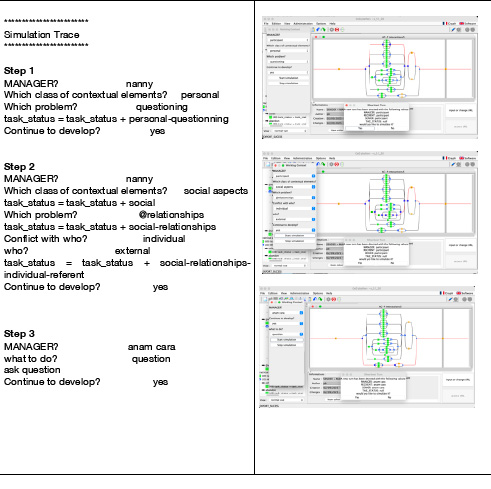
Figure 4 A short simulation of the preliminary turns during Nanny-Anam Cara interactions
Figure 4 shows a specific exchange (three turns) between the nanny and the anam cara that can be followed in the trace of the simulation on figure 4. At the first step, the nanny states that she does not feel comfortable, and has questions about the family. The next crossing (step 2) is triggered by the nanny for completing her first utterance (a conflict with an external referent), and step 3 is for the Anam Cara. In step 2, spontaneously the nanny completes her position by saying that the problem is with an external referent that the family respect the authority. The step 3 just indicates that the anam cara ask the nanny a question to clarify what the trap is exactly. Different types of interaction can be represented, completing an answer like in step 2, the nanny can come back on what she said after a comment of the anam cara, the goal of the exchanges being to lead the nanny to revise her initial judgment on the trap. The conversation can also concern technical points like what to look after when the baby does not seem well.
Moreover, the example illustrates two other important features of the CxG formalism, namely a real-time definition of context and a modelling of the contextual reasoning. The proceduralized context provides a structure on the evolution of the interactions than can be « replay » later, thanks to its representation as an ordered sequences of instantiated contextual elements (with initially RECIPIENT = nanny). For example, context development during step 1 is described as:
MANAGER(Nanny) - Class—contextual_elements(personal) - Personal
problem(questioning) - [actions] - Continue_to_develop(yes) - RECIPIENT(nanny)
It is also possible to model contextual reasoning by adding to the proceduralized context the action executed once a contextual element is instantiated:
MANAGER(Nanny) - Class_contextual_elements(personal) - Personal
problem(questioning) - TASK_STATUS(+personal-bad_mood) + Action 143 -
Continue_to_develop(yes) - RECIPIENT(nanny)
In that sense, the proceduralised context appears as the real-time context and a context-based model of the contextual reasoning.
Another connection can be made with decision-making. Simon (1979) proposed a framework for describing decision-making process with four phases, intelligence, design, choice, review. This holistic view on decision-making can be reviewed in a concrete view in the CxG formalism where « intelligence » consists of the selection of the relevant contextual elements, « design » is the progress on a path in the contextual graph by the ordered instantiation of the contextual elements, « choice » correspond to the elementary decision to make (either choice on the following contextual element to instantiate or the execution of an action), and « review » is to reflect the result of the local decision at the global level of the decision-making process.
Related works
There are very few works in the literature on modelling and use of context in real-world applications (see Brézillon, 2023, for an extended presentation). A reason is theoretical attempts to use existing tools like Logics in which context is considered as a first-class object. The two main schools were around John McCarthy (with later, Buvac), and Fausto Giunchiglia and his team in Trento (Italy). Main divergence with our research were different grounds for modelling context because their orientation toward logics is not directly concerned by modelling context in real-world applications. Nevertheless, two important findings of McCarthy (1993) resonate with ours:
(1) A context is always relative to another context with the corollary that context cannot be described completely because it has an infinite dimension;
(2) When several contexts occur in a discussion, there is a common context above all of them into which all terms and predicates can be lifted.
There are other pragmatic approaches like ours. For example, Dey (2001) and his team have a bottom-up approach of context-aware applications based on the context toolkit, not human activity (more top-down). The popular definition given by Dey is "Context is any information that can be used to characterise the situation of an entity. An entity is a person, place, or object that is considered relevant to the interaction between a user and an application, including the user and applications themselves." It is easy to retrieve our four sources of context. The Context Toolkit contains a combination of features and abstractions to support context-aware application builders. The approach aims to acquire a certain type of context information (generally through sensors) and it makes that information available to applications in a generic manner, regardless of how it is actually sensed and modelled. Thus, the origin of context for Dey is more on data and information than on knowledge and reasoning as in our approach.