Nanny-Anam Cara interactions example Part one
In a situation of radical change, nanny’s feeling is to have not the crucial information about her ability to assume the position, and looks for a support for enriching her context of the situation for making the right decision. Generally, support comes after a triggering event, a person that manifest an empathy for the nanny, either a close person like the grandmother of the baby or an external person. In Psychology, such a person, which is called Anam Cara (soul friend in the Irish story), and the nanny establish a shared context within human consciousness that gives access to this world through its operations (Bedi et al., 2026).
An anam cara only advises or suggests the actor on mental-model building for avoiding the trap. In the CxG formalism, the contextual graph corresponds to the mental representation (the sum of the mental models developed by the actor), and a mental model is a path in the contextual graph. Based on her experience with other actors, the anam cara's intervention concerns the co-management of contextual elements and their instantiations in the mental model for a "problem to be fixed » of the nanny. The anam cara encourages the nanny, based on the shared context, to overcome the trap the nanny might otherwise never have crossed on her own. The encouraging presence of the anam cara would be like the truest mirror for the nanny to change of mental model to fix the problem by modifying her line of reasoning by proposing new contextual elements, or simply different instantiations of known contextual element.
The context-based modelling of actor-Anam Cara interaction is realized in the CxG_2.0 version of the CxG formalism (Brézillon, 2023). The modelling is inspired of an experiment for supporting nannies in Hong Kong who have an offer from a family for taking in charge their new born/young children because the parents are away of their home most of the days (Luk 2026). Nanny stays at home for 8 hours a day during 30 to 45 days (post-partum time) once baby born. Employment period being short (less than two months), the nanny is unlikely to play an anam-cara with the child, which is the role of the mother, but to sustain relationships of the mother with the baby. Nanny activity has several aspects to manage baby care, a role of anam cara for the mother, the contact for the immediate family (husband, siblings of the baby and of the parents, and grandparents) and control social influences that may put pressure on baby care, directly or indirectly through the mother like family tradition and religion. However, the mandatory rule for the nanny is to follow parents' instructions and keep inform them.
Thus, saying YES to parents' offer are supposed to assist working parents to release from pressures on baby caring and help the mother in post-partum with a good caring for speedy recovery. However, contextual factors for deciding to accept the offer of parents may block the nanny to say yes. HK nannies need to feel confident in their ability to "saying YES” and to be sure to sustain their self-love in challenging contexts in very different living and environmental conditions nannies know. Nannies may need an anam cara for helping them to make the right decision in different contexts before to say YES.
The accomplishment of nanny’s activity « solving the problem to be fixed » may move to a new shared context that, once proceduralised, will contain the needed explanations on the problem solving. The anam cara, with an external viewpoint, can guide the nanny to have this type of introspection by putting on the table all the sensible contextual elements--especially those left implicit in the proceduralised context--to propose the nanny another instantiation possible or not, and thus enrich the contextual graph, allow the mental-model accomplishment, and reinforce the self-confident of the nanny.
The nanny has, at least, the elementary competences and skills. Thus, any usual problem occurring in the activity is part of the competences and skills of the nanny. Traps occur when a source of power is in conflict with nanny’s mission. Identify the « sources of power » at the first discussion with parents is important as well as parents’ position on the problem. An anam cara can help the nanny on such conflictual situations. The nanny must always follow the parents’ instructions, not the grandparents’, unless the parents have explicitly delegated authority. For example, medication, medical appointments, daily care are stipulated by parents, not grandparents. Nanny’s attitude must stay respectful (no direct conflict with grandparents, firm but polite (I’m following what Mom and Dad asked me to do), neutral (not taking sides, just applying parental rules), transparent (informing parents if grandparents tried to override their decisions).
On this basis, we are modelling nanny’s mental representation of her activity in a contextual graph, knowing that mental-model development in a specific context is a path in the contextual graph. The cyclic use of the contextual graph allows to manage successive questions between the anam cara and the nanny, leading to modify the context of the trap for YES (and eventually fixing rules to respect). A complete model will be developed later. The nanny example is based on five classes of contextual elements (personal, activity, situation, social aspects, practical aspects) as established in the study of the analysis of an internship offer by students (Brézillon, to appear). The goal is to model the problem solving (the trap) that appear in these classes, not directly the activity itself. For example, the trap can be a conflict with a referent and the nanny then has another problem of loss of motivation. In that sense, the model focussing on trap solving is a behavioural model of the nanny.
The crossing of the contextual graph represents the reasoning held by the nanny that follows a path in the graph, that is, the proceduralized context (the ordered sequence of instantiated contextual elements). Reserved contextual element "task_status" is an accumulation of traps, mood being a contextual element instantiated at « bad ». A crossing of the contextual graph corresponds to a reasoning step held by the nanny. For example, after questioning (personal class), the next nanny’s reasoning step explains that there is a conflict with an external referent. The cyclic use of the contextual graph offers the opportunity to develop a reasoning (personal or collective) step by step. The collective reasoning (anam cara and nanny) is developed during interactions until the shared context stops to be modified.
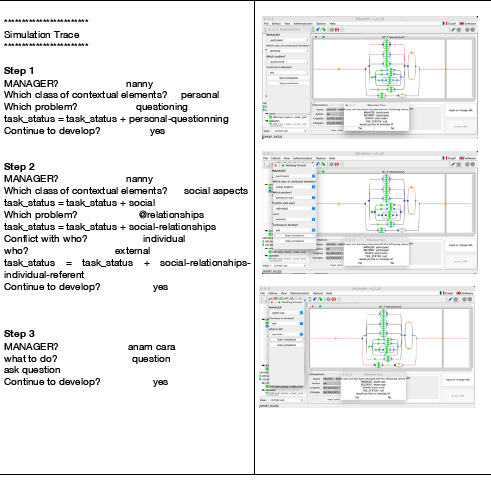
Figure 3 Contextual Graph for Nanny-Anam Cara interactions
On figure 3, the contextual graph represents contextual elements organised in the initial classes (personal, situation, activity, social aspects, practical aspects), and only the nanny part is (very partially) developed. Green square boxes represent actions (sentences in this application like « I have the feeling of pressure with different aspects » in action 143). Light brown squares represent the instantiation of reserved contextual elements (in capital letters). The blue circles represent contextual elements that need to be instantiated. The crossing of the contextual graph corresponds to the execution of an independent task by either the nanny or the anam cara, although that now this part is not yet developed for the anam cara. The series of crossings constitutes a CxG-based simulation (see figure 4).
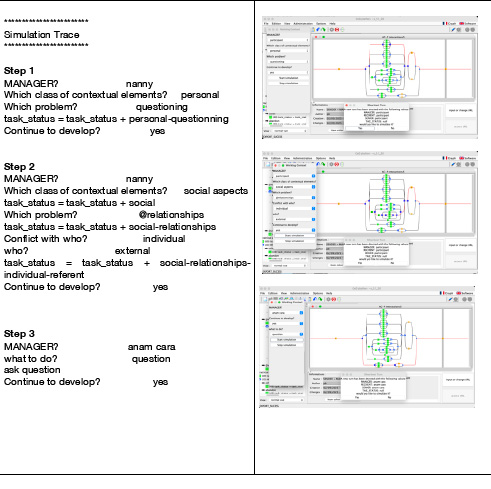
Figure 4 A short simulation of the preliminary turns during Nanny-Anam Cara interactions
Figure 4 shows a specific exchange (three turns) between the nanny and the anam cara that can be followed in the trace of the simulation on figure 4. At the first step, the nanny states that she does not feel comfortable, and has questions about the family. The next crossing (step 2) is triggered by the nanny for completing her first utterance (a conflict with an external referent), and step 3 is for the Anam Cara. In step 2, spontaneously the nanny completes her position by saying that the problem is with an external referent that the family respect the authority. The step 3 just indicates that the anam cara ask the nanny a question to clarify what the trap is exactly. Different types of interaction can be represented, completing an answer like in step 2, the nanny can come back on what she said after a comment of the anam cara, the goal of the exchanges being to lead the nanny to revise her initial judgment on the trap. The conversation can also concern technical points like what to look after when the baby does not seem well.
Moreover, the example illustrates two other important features of the CxG formalism, namely a real-time definition of context and a modelling of the contextual reasoning. The proceduralized context provides a structure on the evolution of the interactions than can be « replay » later, thanks to its representation as an ordered sequences of instantiated contextual elements (with initially RECIPIENT = nanny). For example, context development during step 1 is described as:
MANAGER(Nanny) - Class—contextual_elements(personal) - Personal
problem(questioning) - [actions] - Continue_to_develop(yes) - RECIPIENT(nanny)
It is also possible to model contextual reasoning by adding to the proceduralized context the action executed once a contextual element is instantiated:
MANAGER(Nanny) - Class_contextual_elements(personal) - Personal
problem(questioning) - TASK_STATUS(+personal-bad_mood) + Action 143 -
Continue_to_develop(yes) - RECIPIENT(nanny)
In that sense, the proceduralised context appears as the real-time context and a context-based model of the contextual reasoning.
CONCLUSION
Another connection can be made with decision-making. Simon (1979) proposed a framework for describing decision-making process with four phases, intelligence, design, choice, review. This holistic view on decision-making can be reviewed in a concrete view in the CxG formalism where « intelligence » consists of the selection of the relevant contextual elements, « design » is the progress on a path in the contextual graph by the ordered instantiation of the contextual elements, « choice » correspond to the elementary decision to make (either choice on the following contextual element to instantiate or the execution of an action), and « review » is to reflect the result of the local decision at the global level of the decision-making process.
This scientific approach was applied over 25 years of research on how to model and use context in real-world applications on a spectrum from technology-centred to human-centric applications, that is, from well-defined domains to not formal ones, but all having the goal to model an activity. The presentation is discussed on the example “nanny - anam cara interactions” has all the necessary ingredients to explain the potentiality of the proposed approach.
Our research is part of an approach to designing and implementing AI systems that aim to understand actor(s) through their decisions, actions, and behaviours. Modelling actors’ experience was central to our research and led at a four-level framework: conceptual, operational, implementation and environment levels. For instance, contextual knowledge (conceptual level) is represented as contextual elements (operational level) and designed as a pair of contextual and recombination nodes (implementation level). The model of an activity has two sides, an operational one, on that an actor uses for accomplishing an activity based on a mental model drawn from his mental representation, and an implementation one, a contextual graph that can be used and readable by other actors. The focus of attention for modelling activity allows dividing separation of context in contextual knowledge and external knowledge. The explicit integration of context in the representation (through contextual elements and their instantiations) follows the human style of actors’ activity (collecting and structuring information, making decisions, and acting). On the AI side, the CxG formalism of representation plays the role of a "concept revealer" in a model.
We consider that a mental model is either a path in the contextual graph (in actor activity modelling) or a sequence of independent subtasks that define actors’ activities (in group activity modelling). The mental model is developed from the mental representation in the actor version, but initially must be built in real time from independent subtasks and then developed in the group version. The changes in the group version, with respect to the actor version, are the recording of independent subtasks in the mental representation instead of mental models and the cyclic use of the contextual graph to build a mental model. The notion of group activity is dynamically modelled at two levels: first, at an operational level (turn sequences), and second, at the implementation level (cyclic use of the directed contextual graph). Another important concept is the shared context that makes possible the cyclic use of a directed, acyclic and series-parallel contextual graph and the existence of CxG-based simulation as a natural function of the CxG software. The shared context is used as an inference engine for group-activity building, the engine assuring the turn mechanism in CxG-based simulation. A turn is a local contribution of an actor to the group activity, and the turn mechanism plays a synchronizer role in the dynamic assembling of independent subtasks for building mental models, thanks to reserved contextual elements that monitor turn management. The CxG-based simulation is a function of the CxG formalism for group activity. This tool also offers the possibility of managing other tasks simultaneously (jointly with their realization), such as negotiation, changes in objectives, and looking ahead, thanks to context management. It is possible to “replay” the simulation in different contexts.
Contextual reasoning explains the mental-model development as a path from the input to the exit of the contextual graph, on which contextual elements are instantiated. Contextual reasoning can be nonlinear (e.g. g., local search, voting system, or the Contextualisation-Decontextualization-Recontextualization approach) (Brézillon 2023), and contextual elements themselves, with their implementation as pairs of contextual and recombination nodes, behave as units of contextual reasoning at an operational level. The CxG formalism is effective for modelling an activity, not for visualising its evolution. A tree representation supports a simple visualisation of contextual reasoning (and all its known variants) in the CxG formalism. The mental-model tree view shows to actors the relevant contextual elements as a proceduralized context (the ordered sequence of instantiated contextual elements) and postpones actions to quickly make decisions.
By putting context front stage in the Contextual-Graphs formalism, we obtain a uniform representation of knowledge, information, reasoning and context coming from sources of different natures. We thus have been able to model activities in very different domains (subway, army, different types of cancer in medicine and workflows), thanks to the Contextual-Graphs formalism that is very simple to use. Finally, the CxG formalism is a passport for intelligent systems based on human experience. The “hard kernel” of our approach is the explicit modelling of context in activity, which leads to a homogeneous view of how a class of AI systems can become context-based intelligent systems, especially context-based intelligent assistant systems (CIASs) (Brézillon 2023) which aim at reuse and extend human experience based on how this experience grows. CIASs developed in the CxG formalism offer the possibility to model contextual reasoning with context-based simulation, a powerful modelling tool for CIASs.